Central Iowa remodeling guides
Best basement flooring options for Iowa homes
The best basement flooring for Iowa homes in 2026, ranked by moisture resistance and cost. LVP wins overall; epoxy wins for damp slabs.
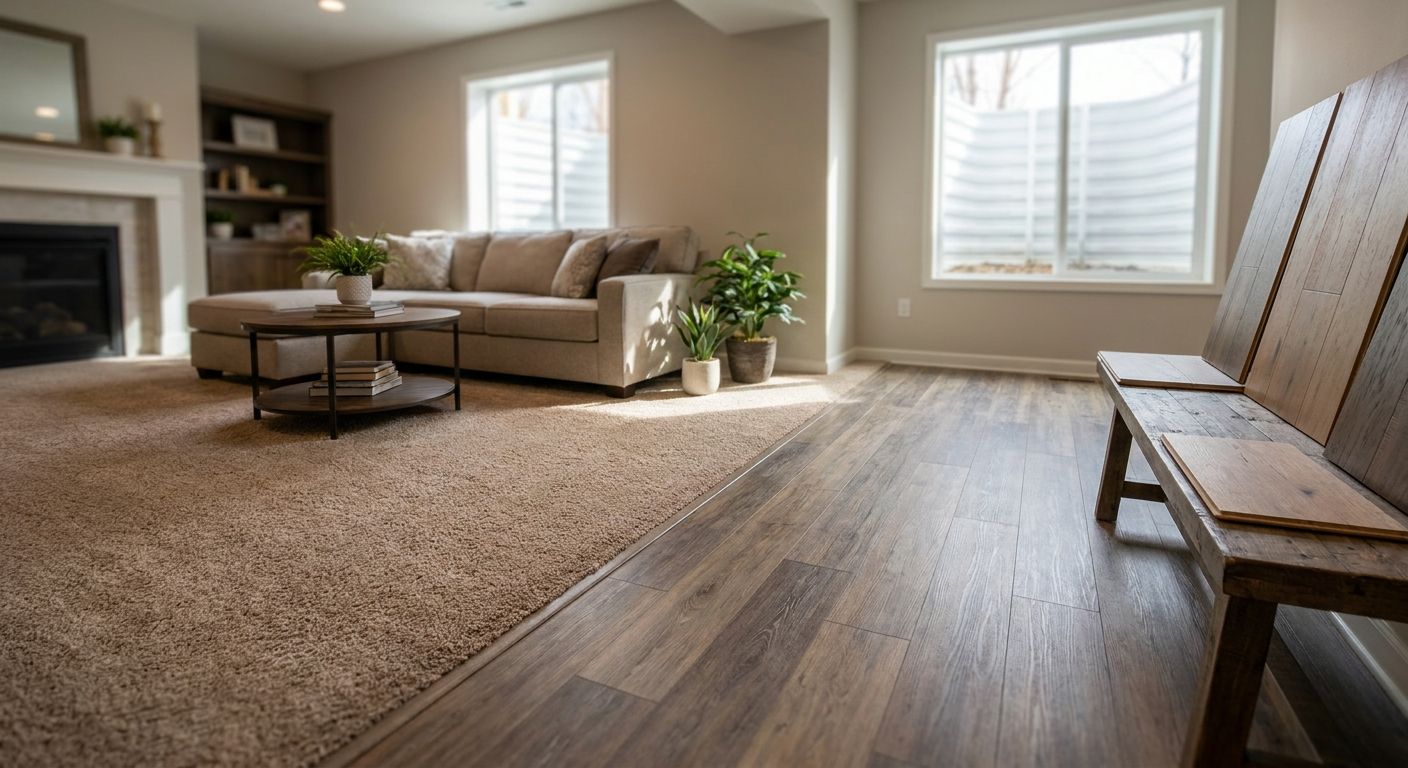
Central Iowa basements deal with humid summers, cold concrete slabs, and the occasional sump pump workout after spring rain — the material you put down decides whether that finished basement holds up through a decade of freeze-thaw cycles or gets ripped out in five years. Best overall: luxury vinyl plank (LVP). Best for moisture-prone slabs: epoxy or polished concrete. Best budget option: carpet tile squares.
- Luxury vinyl plank is the best basement flooring Iowa homeowners can install for moisture resistance and value in 2026.
- Epoxy and polished concrete win when a slab has a history of dampness or past flooding.
- Carpet tile squares are the budget pick — damaged sections replace individually instead of ripping out the whole room.
- Engineered hardwood and solid tile carry real moisture risk below grade and rank last on this list.
- Rubber flooring is the clear choice for a basement home gym.
Why this matters
A basement slab in Carlisle or Ankeny sits below Central Iowa's frost line, which runs roughly 42 inches deep across most of the metro — that's why the concrete stays cold and slightly damp most of the year, even in a dry basement. Flooring that looks fine in a photo can trap moisture against the slab, warp, or grow mold within a season if it's the wrong material for a below-grade room.
If you're weighing a full build-out against a flooring swap, check the actual numbers first — basement finishing cost in Des Moines breaks down what drives the bill beyond the floor itself. Flooring is one line item in a larger project, and the choice you make here affects framing, subfloor prep, and how the room gets used for the next 10-15 years.
What makes the best basement flooring in Iowa
- Moisture resistance — can it handle slab humidity and an occasional sump pump hiccup without swelling or growing mold
- Thermal comfort — does it stay warm underfoot or does it feel like standing on a garage floor
- Subfloor prep required — does it need a vapor barrier, leveling, or a raised subfloor system first
- Durability under daily use — kids, pets, a home gym, a laundry room — basements take abuse
- Maintenance — how often it needs resealing, refinishing, or deep cleaning
- Resale value — whether a future buyer sees it as a finished room or a fix-it project
Basement flooring options at a glance
| Option | Best for | Standout feature | Key limitation |
|---|---|---|---|
| Luxury Vinyl Plank (LVP) | Whole-basement value | Waterproof core, click-lock install | Can feel cold without underlayment |
| Epoxy / Polished Concrete | Slabs with past moisture issues | Seals the slab itself | Limited warmth and softness |
| Carpet Tile | Budget-conscious family rooms | Damaged squares swap individually | Traps moisture if the slab isn't sealed first |
| Rubber Flooring | Home gyms and workout rooms | Shock absorption, easy cleanup | Utilitarian look, limited color range |
| Ceramic / Porcelain Tile | Wet bars and basement bathrooms | Fully waterproof surface | Cold, hard, higher install cost |
| Engineered Hardwood | High-end finished basements with humidity control | Real wood look | Highest moisture risk of the group |
1. Luxury Vinyl Plank (LVP): best basement flooring for moisture resistance and value
LVP is a rigid or flexible plank with a waterproof core, usually topped with a wear layer in the 12-mil to 20-mil range for residential basement use. It clicks together over a thin foam underlayment, so it goes down fast and doesn't require the slab to be perfectly flat.
LVP pros:
- Waterproof core handles slab humidity without swelling
- Click-lock installation goes over most existing concrete with minimal prep
- Wide range of wood-look and stone-look finishes
- Individual planks replace without tearing up the whole floor
LVP cons:
- Cheaper sheet vinyl-style products scratch faster than the mid-grade lines
- Still feels cool underfoot without a foam or cork underlayment
LVP pricing: costs vary by grade and square footage — get a project-specific number through basement finishing companies near you in Central Iowa rather than a national average that won't match your slab condition.
Best for: homeowners who want one flooring type for the whole basement and don't want to think about moisture again. Verdict: Buy.
2. Epoxy or Polished Concrete: best basement flooring for slabs with a history of dampness
Epoxy coating and polished concrete both work with the existing slab instead of covering it up. Epoxy is a multi-coat resin system that seals the surface; polished concrete grinds and densifies the slab itself for a smooth, semi-glossy finish.
Epoxy/polished concrete pros:
- Seals the slab against moisture instead of trapping it under a floor covering
- No subfloor buildup, so ceiling height stays the same
- Extremely low maintenance once cured
- Handles heavy basement use — workshops, storage, laundry
Epoxy/polished concrete cons:
- Hard and cold underfoot with no give
- A previously flooded or actively leaking slab needs the moisture problem fixed first, not just coated over
Best for: a basement with a known history of dampness where you want the slab itself protected rather than hidden. Verdict: Buy, once the moisture source is confirmed and addressed.
3. Carpet Tile: best basement flooring for a budget-friendly family room
Carpet tile squares click or peel-and-stick into place over a vapor barrier. Unlike broadloom carpet, a single stained or damaged square lifts out and gets replaced without redoing the room.
Carpet tile pros:
- Lower material cost than most hard-surface options
- Warm and soft for a playroom or media room
- Damaged sections replace individually
- DIY-friendly installation for handy homeowners
Carpet tile cons:
- Traps moisture and odor if installed without a proper vapor barrier underneath
- Not a fit for basements with any active water intrusion history
Best for: a finished basement used as a family hangout space on a tighter budget. Verdict: Buy, with a vapor barrier underneath — non-negotiable.
4. Rubber Flooring: best basement flooring for a home gym
Rubber tiles or rolled rubber flooring absorb impact from dropped weights and equipment, and they wipe clean in seconds. It's a narrow-use pick, but it's the right one for that use case.
Rubber flooring pros:
- Shock absorption protects the slab and reduces noise transfer upstairs
- Waterproof and easy to clean
- Handles heavy equipment without denting
Rubber flooring cons:
- Limited color and finish options compared to LVP or tile
- Not a natural fit for a living room or bedroom look
Best for: a dedicated workout or equipment room, not a whole-basement solution. Verdict: Buy, for that one room only.
5. Ceramic or Porcelain Tile: best basement flooring for a wet bar or basement bathroom
Tile is the fully waterproof option, which makes it the right call in any spot with direct water exposure — a wet bar, a basement bathroom, a laundry nook.
Tile pros:
- Completely waterproof surface, no exceptions
- Handles standing water from a spill or minor leak without damage
- Wide range of styles, including large-format planks that mimic wood
Tile cons:
- Cold and hard underfoot without in-floor heat
- Higher installation cost and labor time than LVP or carpet tile
- Grout lines need periodic resealing
Best for: the specific wet zones of a basement, not necessarily the whole floor plan. Verdict: Buy, for wet-use rooms.
6. Engineered Hardwood: best basement flooring for a controlled, high-end build-out
Engineered hardwood has a real wood veneer over a plywood core, which handles humidity better than solid hardwood — but it's still wood, and wood and below-grade concrete are not natural partners.
Engineered hardwood pros:
- Real wood look and feel, unmatched by vinyl
- Adds resale appeal in a high-end finished basement
Engineered hardwood cons:
- Highest moisture risk of every option on this list
- Requires a proven dry slab, a quality vapor barrier, and often a dehumidifier running year-round
- Costliest to replace if it does swell or cup
Best for: basements with a documented dry slab and active humidity control — not a first basement build-out. Verdict: Wait, until moisture control is proven over at least one full Iowa humidity cycle.
How we ranked these
Each option was weighed against the six criteria above, with moisture resistance carrying the most weight since it's the single biggest failure point for basement flooring in Iowa. LVP scored highest because it clears every criterion without a major weakness; engineered hardwood ranked lowest because it fails the moisture test even with careful installation.
“If your basement has flooded even once, treat the slab like a bathroom floor, not a bedroom floor.”
Which basement flooring should you choose?
For most Central Iowa basements in 2026, luxury vinyl plank is the default pick — it handles slab moisture, installs fast, and doesn't force a tradeoff between looks and durability. If the slab has flooded before, seal it with epoxy or polished concrete before anything else goes down. On a tight budget, carpet tile over a vapor barrier gets a family room finished without the moisture risk of wood.
A finished basement in Carlisle, Iowa needs the same moisture logic as one in West Des Moines or Ankeny — the flooring decision doesn't change by zip code, but the slab condition and subfloor prep usually do. That's the part worth a second set of eyes before material shopping starts.
Get your basement flooring plan reviewed
Phoenix Construction Solutions checks slab condition before you buy flooring.
FAQ
What is the best basement flooring for Iowa homes in 2026?
Luxury vinyl plank is the best basement flooring for most Iowa homes in 2026 because it resists slab moisture and installs without major subfloor work. Epoxy or polished concrete is the better call on a slab with a history of dampness.
Is carpet a bad idea for a basement floor?
Standard broadloom carpet is a poor fit for basements because it traps moisture against the pad and slab. Carpet tile squares over a proper vapor barrier are a safer version of the same look.
Can you put hardwood flooring in a basement?
Solid hardwood should not go in a basement because it swells and cups with slab moisture. Engineered hardwood handles it better but still carries the highest moisture risk of any option on this list.
Do I need a vapor barrier under basement flooring?
Yes, almost every basement flooring option needs a vapor barrier between the slab and the finished floor. Skipping it is the most common reason basement flooring fails within a year or two.
How much does it cost to finish a basement floor in Iowa?
Cost depends on the material chosen, the square footage, and how much slab prep is needed before installation. A breakdown specific to Des Moines-area projects is available in the basement finishing cost guide linked above.
What basement flooring works best over a slab that sometimes gets damp?
Epoxy coating or polished concrete works directly with a damp slab by sealing the surface instead of covering it with a moisture-sensitive material. Luxury vinyl plank is the second-best option once the moisture source is under control.
Is tile a good basement floor option?
Ceramic and porcelain tile are fully waterproof and work well in basement bathrooms or wet bars. They cost more to install and feel cold underfoot without in-floor heat, so most homeowners reserve tile for wet-use rooms only.
One last thing
The flooring choice rarely fails on its own — it fails because the slab underneath wasn't checked first. Before ordering any material, confirm there's no active moisture coming through the concrete; a floor installed over an unresolved leak will need to come back up within a year regardless of how good the product is.